

ONTARIO REAL ESTATE & TENANCY LAW · Effective September 21, 2026Ontario Just Changed the Rules for Landlords and TenantsKnow the new rules. Protect your rights — whether you're a
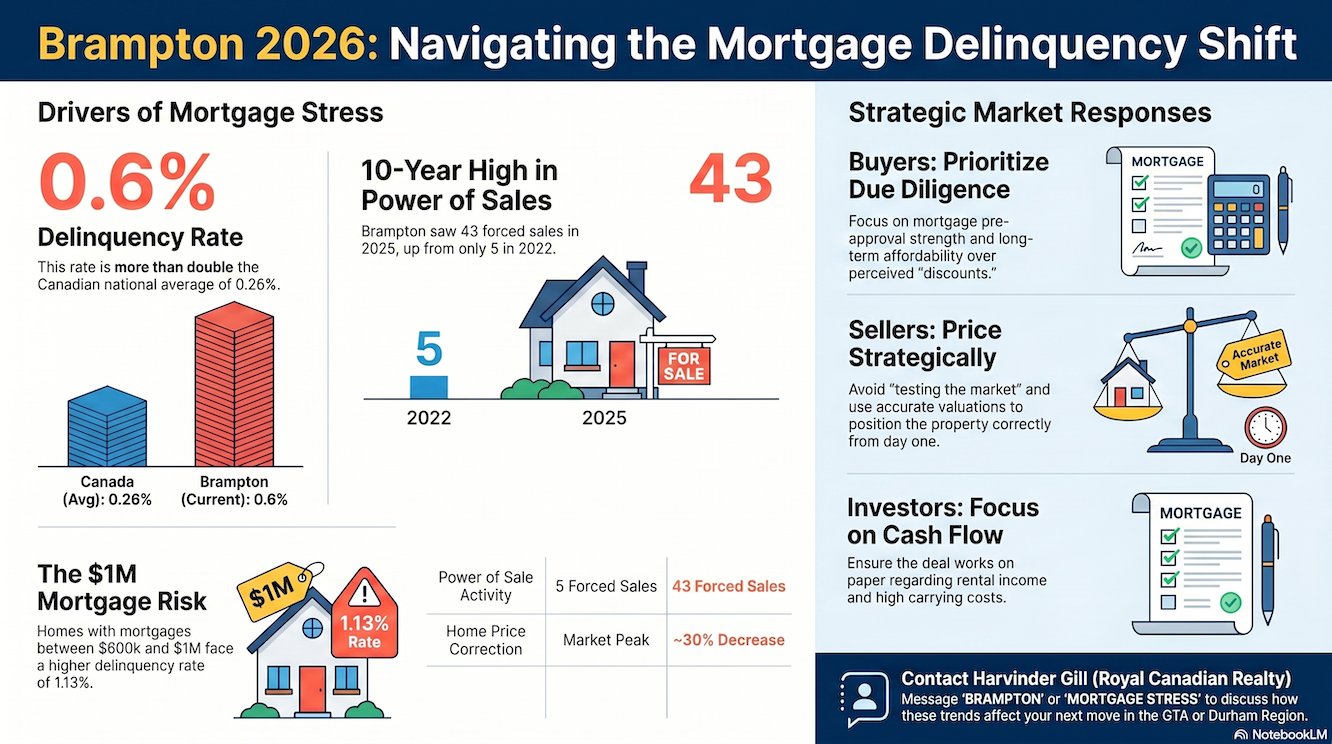
Infographic: Key drivers of Brampton mortgage stress and strategic market responses — Royal Canadian Realty
The Shift That Every GTA Homeowner Needs to Understand
As of early May 2026, Brampton, Ontario has quietly become one of the most consequential housing markets to watch in Canada — not because prices are soaring, but because the signs of mortgage stress are becoming harder to ignore.
New data from Equifax Canada shows that Brampton's 90-day mortgage delinquency rate reached approximately 0.6% in late 2025 and into 2026 — more than double the Canadian national average of 0.26%. And in one of the most telling indicators yet, power of sale activity in Brampton has hit a 10-year high: 43 forced sales in 2025, compared to just 5 during the 2022 market peak.
This does not mean the Brampton housing market is collapsing. But it does mean that buyers, sellers, and investors must understand the shift clearly before making their next move. Smart decisions in this environment require more than intuition — they require data.
Source: The Globe & Mail
Why Is Brampton Under Mortgage Pressure?
The rise in delinquencies is not the result of a single shock — it is the collision of several pressures hitting homeowners simultaneously. Understanding these drivers is essential for anyone making a real estate decision in the GTA right now.
1. Mortgage Renewal Shock
Homeowners who purchased during the 2021–2022 pandemic boom at record-low rates are now renewing at significantly higher rates, creating payment shock that many households were not budgeted for.
2. Price Correction
Brampton home prices have dropped roughly 30% from early 2022 peak levels. This traps some owners: reduced equity means limited refinancing options and potential negative equity at closing.
3. High-Balance Mortgage Risk
Homeowners with mortgages between $800,000 and $1 million face a delinquency rate of around 1.13% — a key warning sign for the detached and semi-detached segments most common in Brampton.
4. Employment Sector Pressure
Brampton has a high concentration of workers in manufacturing, transportation, and logistics. Tariff pressures and sector slowdowns have made household income less predictable — a dangerous combination with large mortgages.
5. Multi-Generational Household Risk
With 14.3% of Brampton households being multi-generational — among the highest in Canada — any income disruption to one contributor can ripple across the entire family's mortgage capacity.
6. Combined Pressure Effect
No single factor alone would create a crisis — but when renewal shock, price decline, income uncertainty, and large balances converge simultaneously, delinquency risk multiplies.
What This Means for Buyers in Brampton & the GTA
For buyers, this market environment may surface more opportunity than in recent years — but opportunity and risk can look identical from the outside. A rise in power of sale listings and motivated sellers does not automatically mean every listing is a bargain.
Key principle for buyers: Do not rush into a purchase simply because a property looks discounted. Discounted from a peak price that was itself inflated may still mean you're overpaying relative to today's realistic market value. The numbers must work.
Buyer Due Diligence Checklist
- Secure a strong mortgage pre-approval at today's rates before viewing any property
- Model your monthly payment at current and stress-tested interest rates
- Order an independent appraisal — do not rely on the list price as market value
- Inspect property condition thoroughly; power of sale homes are sold as-is by lenders
- Review comparable sales from the past 60–90 days in the same neighbourhood
- Factor in all closing costs: land transfer tax, legal fees, home inspection, adjustments
- Have a clear long-term affordability plan, not just a plan for today's payment
- Understand your exit strategy before you enter the deal
Power of sale properties can sometimes offer value, but they require heightened due diligence. The seller in these transactions is typically the lender, and the process differs meaningfully from a standard resale purchase. For first-time buyers, this context is especially important — the process moves differently and emotions can cloud judgment.
For deeper guidance on financing in this environment, see: Mortgage Rate Outlook for First-Time Home Buyers in Ontario (2026 Guide) →
What This Means for Sellers in Brampton
For sellers, the single most important message in this market is this: pricing strategy matters more now than at any point in the past four years.
The market is no longer rewarding optimistic or aspirational pricing. With more homeowners under financial pressure and buyers growing increasingly selective, overpriced listings sit, accumulate days-on-market stigma, require price reductions, and ultimately sell for less than they would have with a well-calibrated strategy from day one.
Seller Strategy Checklist
- Commission an accurate, data-driven comparative market analysis (CMA)
- Price based on recent comparable sales — not your purchase price or emotional expectations
- Invest in professional photography and digital marketing exposure
- Prepare the property for presentation: de-clutter, clean, and address visible deficiencies
- Enter the market with a flexible negotiation posture — rigid sellers lose time and money
- Consider timing: the longer you wait, the more competing listings may emerge in your area
- Work with an agent who understands local Brampton market data, not just GTA-wide trends
The goal is not to "test the market." The goal is to position the property correctly from day one — so that qualified buyers find it, engage with it, and compete for it rather than waiting for a price reduction.
What This Means for Investors
Brampton's mortgage stress environment presents both genuine opportunity and real risk for investors. The two can look strikingly similar without careful analysis.
Potential opportunities include: motivated sellers with flexibility, power of sale inventory priced to move, long-term rental demand driven by immigration and affordability pressures, and multi-family housing demand that continues to grow.
But investors must be cautious. A lower purchase price does not automatically create a good investment. High carrying costs, property taxes, maintenance reserves, financing terms, vacancy risk, and landlord obligations must all be modelled realistically before committing.
The investor's core question: Does this property cash flow at today's rates, with a realistic vacancy allowance and full expense load? If the answer is no, price alone is not the justification. There must be a clear long-term value-add or appreciation thesis grounded in local data.
Is This a Warning for the Entire GTA?
Brampton's situation is serious, but it does not indicate uniform distress across the Greater Toronto Area. Markets are hyper-local, and conditions vary significantly between neighbourhoods, property types, and price segments.
However, Brampton does offer a preview of what can happen when several pressures converge at once: mortgage renewals at higher rates, declining property values, income uncertainty in key employment sectors, and high mortgage balances relative to current property values.
Markets including Mississauga, Caledon, Vaughan, Ajax, Pickering, Oshawa, Whitby, Clarington, and parts of Toronto may experience versions of these same pressures — particularly where buyers purchased at or near peak prices with large mortgage balances. Local analysis matters. A city-wide or national headline will not tell you what is happening on your specific street, in your property type, at your price point.
Key Takeaways for 2026
- Brampton's delinquency rate of 0.6% is more than double Canada's national average — this is a structural shift, not a blip
- 43 power of sale events in 2025 (up from 5 in 2022) signals real financial stress among homeowners
- Homeowners with $800K–$1M mortgages face a 1.13% delinquency rate — the highest-risk segment
- For buyers: opportunity exists, but only with disciplined financing and rigorous due diligence
- For sellers: strategic pricing and preparation from day one is non-negotiable in this market
- For investors: the deal must work on paper — rental income must cover carrying costs at real numbers
- Adjacent GTA markets may face similar dynamics, making local expertise more valuable than ever
Thinking About Your Next Move in the GTA?
Whether you're a buyer looking for opportunity, a seller worried about timing, or an investor evaluating distressed inventory — get a clear picture before you act.
Harvinder Gill · Royal Canadian Realty · Serving Brampton, Mississauga, Oshawa, Durham Region & GTA
 Toronto Real Estate Board (TRREB); All information deemed reliable but not guaranteed. All properties are subject to prior sale, change or withdrawal. Neither listing broker(s) or information provider(s) shall be responsible for any typographical errors, misinformation, misprints and shall be held totally harmless. Listing(s) information is provided for consumer's personal, non-commercial use and may not be used for any purpose other than to identify prospective properties consumers may be interested
